Показ дописів із міткою купити вишиванку в києві. Показати всі дописи

субота, 2 лютого 2013 р.

Чернігівська вишивка


Чернігівська вишивка

Для Чернігівщини до початку 1960-х років були характерні вишивки білими або червоними та чорними, інколи з обмеженим додаванням синіх ниток. Вишивки Полісся прості і чіткі за композицією. Ромбо-ламана лінія геометричного орнаменту повторюється кілька разів і на сіро-білому тлі лляного полотна вирізняються графічною чіткістю. Дуже поширеними були мотиви дерева життя та берегині, птахів, солярних символів. Ці мотиви присутні на речах домашнього вжитку: наволочках, скатерках, хустках, а також на рушниках. Традиційно на Чернігівщині вишивкою прикрашали жіночий та чоловічий одяг: сорочки, жіночі головні убори, спідниці. Жіночі сорочки оздоблювались на рукавах вишивкою білими нитками безкінечними варіаціями геометризованих та геометричних сюжетів. Любили вводити до білих вишивок невеликими вкрапленнями червоний, чорний та синій кольори. Традиційні техніки: лічильна гладь, мережки, штапівка, вирізування, виколювання, зерновий вивід. Для підсилення загальної виразності в одній роботі використовували кілька типів швів. Так, дуже характерним в поєднанні прозорих швів (мережки, виколювання, вирізування) із щільним настиланням лічильною гладдю. Рукава з’єднувались із сорочкою широким мережаним кольоровим орнаментом, так званою чернігівською розшивкою. Така ж розшивка з’єднувала уставку і станок з коміром.

Закарпатська мукачівська вишивка


Закарпатська мукачівська вишивка

Мукачівщина – своєрідний багатонаціональний регіон, де на малому клаптику землі проживають угорці й словаки, німці і євреї, велика кількість інших національних меншин. Жінки цього району також, окрім вишивки, займалися й ткацтвом.

Зустрічаються на Мукачівщині як рослинні, так і геометричні орнаменти. Також можна побачити геометричні орнаменти чи власне «мінти» (від угор. minta – взірець, приклад) із вкрапленням рослинних елементів. Мінтою називають орнамент не тільки на Мукачівщині, але й на Ужгородщині, Берегівщині та в інших куточках, де проживають етнічні угорці.
Характерними є зображення «команички» (конюшини), дубового листа. Зустрічається візерунок «на дербанку» – зображення великих квітів, розміщених в ряд по краях виробів.
Серед технік вишивання переважали вирізування, двостороння гладь, хрестик, низина, або, як тут її ще називали, «перетинання» чи «протягування», та болгарський хрестик.
У залежності від того, для чого призначався той чи інший виріб, підбиралася й відповідна вишивка. Наприклад, у деяких селах Мукачівщини по-різному вишивають весільні рушники для молодої та молодого. Для нього – зеленим та блакитним нитками рослинний орнамент із зображенням винограду, а для неї – яскраво-червоними нитками візерунок «на дербанку».
Побутує на Мукачівщині також рушник, який вишивають для обряду поховання. Він вишивається відповідним для похоронного ритуалу орнаментом: для чоловіка темно-синіми нитками роблять узор із зображенням винограду, або «грозна», як звикли тут казати, а для жінки – бордовими нитками квіти.
Щодо кольорової палітри, то переважали на Мукачівщині зелений, синій, блакитний, бордовий та яскраво-червоний. Тепер, поруч із традиційними барвами, використовуються широкий спектр інших кольорів.
Багато вишивальниць на Мукачівщині зараз перебирають візерунки зі сучасних журналів: російських, угорських, словацьких, німецьких. Тут спостерігається тенденція до втрати інтересу щодо збереження традиційних орнаментів, характерних для цієї місцевості, хоча по селах вона й не є такою яскраво вираженою.
Потрібно також відзначити, що саме на Мукачівщині вишивкою займаються й представники німецької общини. Особливо активно вишивають вони в селі Павшино, експонують свої роботи на виставках, навіть організували свою майстерню: вишивають вироби для потреб церкви та на замовлення.

Подільська вишивка


Подільська вишивка

Подільська вишивка — одна з найбільш складних і красивих в Україні. Бездоганні щодо техніки виконання, високохудожні вишивки цієї області зачаровують з першого погляду.
Найкращі полотна ткали в чорноземних районах Поділля, де були особливо сприятливі умови для вирощування конопель. Лляне полотно м'яке, має дрібнішу клітинку, сірувато-охристі відтінки, а конопляне — тугіше, зеленкувато-сірих відтінків. В Україні відомо близько 20 видів полотна. У XIX столітті вишивали лляними, конопляними й вовняними нитками ручного виробництва. Нитки пряли з найкраще вичесаних волокон льону чи конопель, пряли тоненько й рівно, щоб нитка вільно рухалась у вушці голки й легко стелилася на тканині. Потім нитки білили, фарбували, натирали воском або жиром. Нитки для вибілювання золили в діжках-«зільницях». У діжки складали нитки, намотані в півмітки, пересипали попелом із спалених дров і заливали окропом. Лугова вода поступово вибілювала нитки, потім їх прали й висушували на сонці чи на морозі. Такими нитками вишивали, часто комбінуючи із сірими, небіленими, що мали зеленуватий відтінок. Для фарбування використовували кору вільхи, дуба, ягоди бузини, цибулиння. У південних районах Східного Поділля нитки для вишивання змочували гарячою водою з розчином лугу, отриманого від спаленої соломи гречки. В результаті нитки набували світлого вохристого кольору, його називали «пшеничним». Із середини XIX століття стали користуватися привозними бавовняними, вовняними, металевими, шовковими нитками, бісером.
В ансамблі жіночого народного одягу основна увага приділялася багатоорнаментованій сорочці. Подільські сорочки вирізняються не тільки різноманітністю крою, а й витонченістю й багатством декоративного оздоблення. Крій сорочки зумовлює місця розташування вишивки, її композицію. Декоративний акцент у жіночій сорочці зосереджено на рукаві, тій його частині, що зветься поликом. Рукав поділяється на три частини: верхню («поверхниця»), середню («найширший полик») та нижню («підопліччя»). Вишивка на поликах і верхній частині рукава застосовувалася дуже давно, це відгомін праслов'янської символіки, підкреслення сили і вправності руки. Обов'язкова наявність вишитих поликів на рукавах зафіксована на Поділлі в документах XVIII століття. Для сорочок Літинського району Вінницької області характерне «підопліччя», яке іноді вдвоє довше за орнаментальну смугу полика й часто декорується не суцільною смугою вишивки, а окремими мотивами орнаменту — «одскочками», у святкових сорочках прикрашався весь рукав («порукав'я»).
У подільських сорочках, окрім рукава, оздоблюються вузькими симетричними смугами орнаменту площини навколо розрізу пазушки-«погрудки» і «побічниці», або «приборки», які йдуть паралельно «погрудкам». Орнамент «погрудок» часто переноситься й на спину сорочки. Цей принцип розміщення вишивки на спині і грудях характерний як для східних, так і для західних районів Поділля. У вишивці Східного Поділля переважають геометричні мотиви складних сполучень. Мініатюрна розробка їх справляє враження дорогоцінної мозаїки.

четвер, 31 січня 2013 р.

Краватка вишита ручної роботи

Краватка вишита ручної роботи


Тільки задумайтесь, ви українець, володар цієї землі української, і ви носити нащу національну вишивану краватку ручної роботи від Галини Михайлюк.


Справжня українська національна краватка

вівторок, 29 січня 2013 р.

Вишиванка ручної роботи, чоловіча вишита сорочка "Подільська"

Вишиванка ручної роботи, чоловіча вишита сорочка "Подільська"
Артикул 00208
На складі
було
820 ГРН.
690 ГРН.
економія
16%
К-сть
Вишиванка ручної роботи, чоловіча вишита сорочка "Подільська"
БрендВишиванки від Галини Михайлюк http://vyshyvka-ua.blogspot.com/
Вишиванка ручної роботи, чоловіча вишита сорочка "Подільська"
Орнамент - типовий подільський орнамент.
You May Also Like
Вишиванка чоловіча червоним і білим по білому "Панська"
Вишиванка ручної роботи, чоловіча на льоні
Артикул 00001
760 ГРН.
Артикул 00002
580 ГРН.

неділя, 27 січня 2013 р.

Вишиванки від Галини Михайлюк

Вишиванки від Галини Михайлюк

Вишиванки від Галини Михайлюк

Ore. inmates take pride in embroidery


Ore. inmates take pride in embroidery

PENDLETON, Ore. (AP) – The Oregon Legislature and the Eastern Oregon Correctional Institution are 250 miles apart, but a tiny piece of cloth links them – a little Oregon flag with the state seal embroidered on one side and a beaver on the other.

Inmates stitched the miniature flags. When the Legislature convened last week for the 2013 session, lawmakers found them planted in one corner of their desks inside chambers of leather and polished wood.

Four inmates crafted the flags inside the cavernous and decidedly less posh EOCI garment factory in Pendleton, at the request of Senate President Peter Courtney. Previous flags had displayed only the seal, even though statute describes a beaver on the flipside. Courtney decided to present legislators in the Senate and House with accurate flags that he purchased himself.
Each order goes first to the team’s digitizer, Jeff Haney, who creates a design. Haney designed the flag and shrank the seal and beaver to fit. Because the flag has embroidery on both sides, the flag is folded over on itself. Haney didn’t seem taxed though the flag was his first back-to-back (two-sided) embroidery order.
“We can do about any customized work,” he said, rubbing his goatee. “Our quality is really good. We take a lot of pride in what we do.”

Dong ethnic women pass down traditional embroidery craft


Dong ethnic women pass down traditional embroidery craft
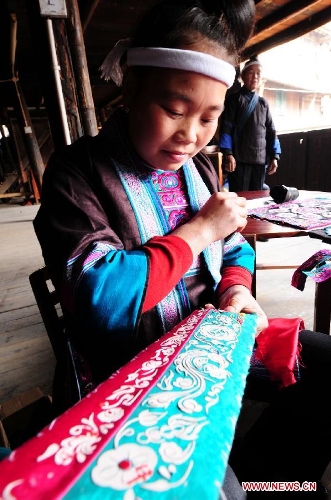
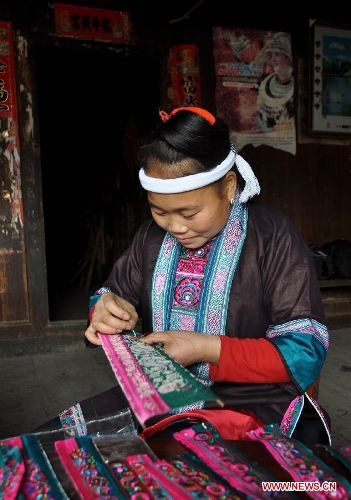
A woman of Dong ethnic group makes embroidery works at Tongle Village in Sanjiang Dong Autonomous County, southwest China's Guangxi Zhuang Autonomous Region, Jan. 26, 2013. The embroidery works made by Dong women have been sold to Britain. (Xinhua/Liang Kechuan)
A woman of Dong ethnic group makes embroidery works at Tongle Village in Sanjiang Dong Autonomous County, southwest China's Guangxi Zhuang Autonomous Region, January 26, 2013. The embroidery works made by Dong women have been sold to Britain. (Xinhua/Liang Kechuan) 

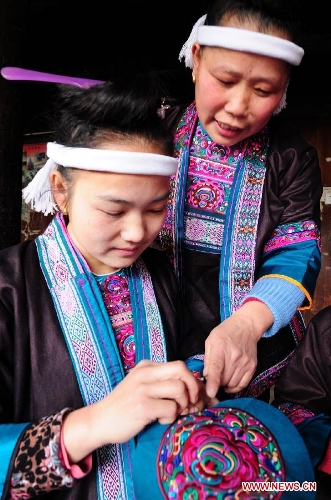
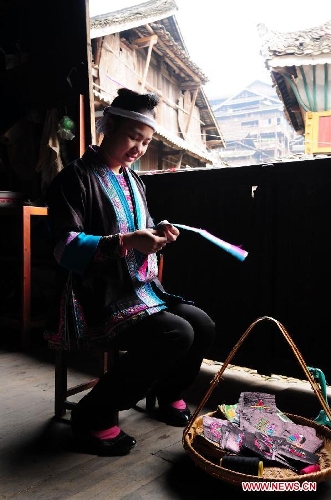
 Women of Dong ethnic group make embroidery works at Tongle Village in Sanjiang Dong Autonomous County, southwest China's Guangxi Zhuang Autonomous Region, Jan. 26, 2013. The embroidery works made by Dong women have been sold to Britain. (Xinhua/Liang Kechuan)
 Women of Dong ethnic group make embroidery works at Tongle Village in Sanjiang Dong Autonomous County, southwest China's Guangxi Zhuang Autonomous Region, January 26, 2013. The embroidery works made by Dong women have been sold to Britain. (Xinhua/Liang Kechuan) 

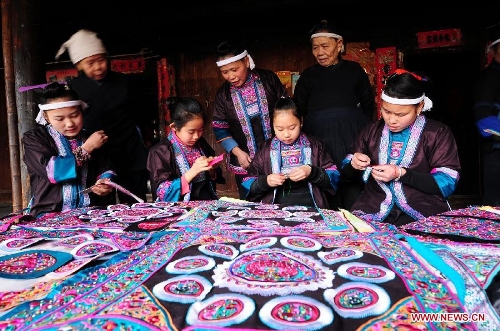
 Women of Dong ethnic group make embroidery works at Tongle Village in Sanjiang Dong Autonomous County, southwest China's Guangxi Zhuang Autonomous Region, Jan. 26, 2013. The embroidery works made by Dong women have been sold to Britain. (Xinhua/Liang Kechuan)
 Women of Dong ethnic group make embroidery works at Tongle Village in Sanjiang Dong Autonomous County, southwest China's Guangxi Zhuang Autonomous Region, January 26, 2013. The embroidery works made by Dong women have been sold to Britain. (Xinhua/Liang Kechuan) 

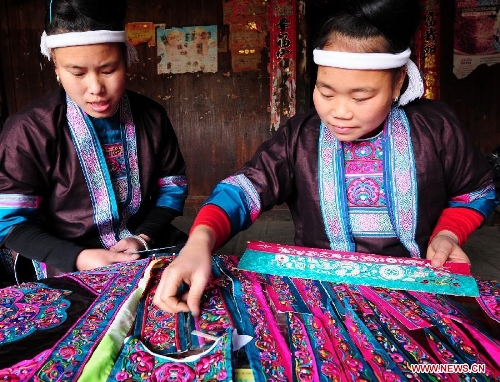
 Women of Dong ethnic group make embroidery works at Tongle Village in Sanjiang Dong Autonomous County, southwest China's Guangxi Zhuang Autonomous Region, Jan. 26, 2013. The embroidery works made by Dong women have been sold to Britain. (Xinhua/Liang Kechuan)
 Women of Dong ethnic group make embroidery works at Tongle Village in Sanjiang Dong Autonomous County, southwest China's Guangxi Zhuang Autonomous Region, January 26, 2013. The embroidery works made by Dong women have been sold to Britain. (Xinhua/Liang Kechuan) 

 A woman of Dong ethnic group makes embroidery works at Tongle Village in Sanjiang Dong Autonomous County, southwest China's Guangxi Zhuang Autonomous Region, Jan. 26, 2013. The embroidery works made by Dong women have been sold to Britain. (Xinhua/Yang Ming)
 A woman of Dong ethnic group makes embroidery works at Tongle Village in Sanjiang Dong Autonomous County, southwest China's Guangxi Zhuang Autonomous Region, January 26, 2013. The embroidery works made by Dong women have been sold to Britain. (Xinhua/Yang Ming) 

  A woman of Dong ethnic group makes embroidery works at Tongle Village in Sanjiang Dong Autonomous County, southwest China's Guangxi Zhuang Autonomous Region, Jan. 26, 2013. The embroidery works made by Dong women have been sold to Britain. (Xinhua/Liang Kechuan)  
  A woman of Dong ethnic group makes embroidery works at Tongle Village in Sanjiang Dong Autonomous County, southwest China's Guangxi Zhuang Autonomous Region, January 26, 2013. The embroidery works made by Dong women have been sold to Britain. (Xinhua/Liang Kechuan)   

Last of the ring ladies


Last of the ring ladies


SITUATED 40km from Kuching, nestled among the mountains of Banjaran Bungo Range and seated on a hilltop 310m above sea level, the more than 300-year-old Kampung Semban is better known as “a paradise in the cloud.”
Kusan Ganyai
However, what sets it apart from many other scenic and pictureque villages ‘sitting in the cloud’ is its ring ladies.
These traditional Semban ladies wearing the ruyang and rusung are the embodiment of the remaining distinctive culture of the Semban, a sub-tribe of the Bidayuhs.
Ruyang and rasung are copper coiled rings worn on the forearms and calves respectively.
There are only a handful of them left. In 2010, there were eight. Last year, there were six and this year until January 20, there were only four.
The lamentation of security and development committee (JKKK) deputy chairman Sagen Adem, 54, that “10 years down the road, the culture of rings wearing will disappear completely” is, thus, acute and understandable.
The Semban ladies started putting on the rings at various ages – some as young as 10 while others older, depending on their parents and their parents’ financial standing.
These coiled rings which look golden but not made of gold, are a mixture of copper and brass. Despite so, they were not cheap, especially in the old days when demand was high and the rings were only available when travelling vendors brought them into the village after trekking for hours through a jungle, green padi fields, rivers, waterfalls and countless bamboo steps.

No one knew where these coiled ornaments came from. When batter trade was still in practice back then, a big mature pig was needed to exchange for a set of ruyang or rasung.
So for ring lady Kusan Ganyai, who estimated her own age to be 80, her ruyang and rasung meant two mature pigs, costing about RM1,400 today.
That was not all. As Semban girls started wearing the rings as young as 10, they had to change to a bigger ones while growing up. To date, Kusan has made three ring changes, costing her in total six big pigs.
Beauty precedes all
In the beginning, it was painful putting on the rings and all the ring ladies grew up with atrophied limbs. However, like most women, beauty precedes everything and the pain was worth it.
What is even more amazing is that the wearers do not take off the rings when doing their daily chores. The rings have become part of their daily dressing up.
The Semban womenfolk till the padi fields under the scotching sun with the rings on and they also wear them when showering in the cold mountain water pumped into their house through gravity feed.
To reduce friction, leaves of any plants are placed between the rings and the calves or the forearms. Kusan uses citrus fruit juice to clean and polish the rings so that they continue to shine like gold.
The Sembans, as a sub-tribe of the bigger Bidayuh society which have generally been egalitarian in nature, do not impose wearing of the rings on their fair sex. It has been the choice of the girls themselves.
Sweet and innocent
Apart from being a symbol of status and beauty, there is much more to wearing the rings.
The practice which has been around for centuries, was actually paganistic in nature. In the old days, according to pagan customs, only girls with the rings were allowed to attend festive ceremonies and do the rejang – the eagle dance.
“Only ring girls were allowed to dance during festive celebrations. It was a shame for a girl without rings to dance – that was why all the girls wore them even though no one forced them to.
“I wanted to be at all the festivals. Festivals meant fun and I wanted to have fun. That was why I put on the rings,” said Kusan, who, despite her advanced age and having one granddaughter, still appears sweet and innocent – like a young girl.
As wearing the rings was a symbol of beauty, “ringless” girls would have difficulty finding a husband. Though no force was involved, girls of the village chose to wear the rings due to social pressure.
“Anyway, we don’t feel complete as women if we don’t wear the rings. Wearing them makes us complete,” Kusan said.
Even today when the ring culture has been abandoned by most, Kusan still believes these traditional ornaments enhance her beauty. For this reason, she will not take them off – apart from the fact that the wearing and taking off process is tedious, requiring a day to do each.
Other ornamental gadgets
SEMBAN TREASURES: Heirlooms for Sagen – bangles, siset peilak (silver belts), tumbih (beaded necklace) and bulang toko (head gear). The guwe (copper jar) was used to keep bettel leaves and nuts, tobacco leaves, gambir (a type of spice) and lime. The Semban basket is called Juwah.
There are many other ornamental gadgets for a Semban woman. And everyday, Kusan puts on her colourful beaded necklace called tumbih which she made herself.
Hidden underneath her tee-shirt was another piece of ornament she wears daily – the sising wii or ring belt.
“We Semban women wear them to keep our waistline slim. We wear them also because they make us look pretty,” Kusan beamed.
The original sising wii is made of some wire material and copper rings. However, as the practice of wearing this ring belt is vanishing, Kusan, who could not find the original item, is making do with something similar – a stainless steel shower hose.
There are two other important ornaments that Kusan only wears at special functions – a headgear called bulang toko, made of colourful beads, and a sash called kain hgumban.
Traditionally, Semban women like their Bidayuh counterparts, wear black skirts with embroidery. As there is no tradition of wearing undergarments, a Semban woman always makes sure she sits properly – either slanting both legs to one side or stretch them out to full length.
This posture makes Kusan look sweet and ladylike. To her and Bidayuh men, a Semban woman sitting cross-legged is considered rude, crude and impolite.
Preserving traditional culture
Sagen has commented that the Semban culture is one of the best and most elaborate among all the sub-tribes of the Bidayuhs. And he is right.
HIGH UP: Kampung Semban, one of the oldest Bidayuh villages in Sarawak, is 310M above sea level.
To the (JKKK) deputy chairman, Kampung Semban, with its 59 houses and 450 villagers, means more than just home. It is the last stronghold of the Semban culture.
Though having only six years of primary education, Sagen, who has been operating a homestay, is a far-sighted village leader with a mission to preserve whatever remnants of traditional culture Kampung Semban still retains.
So much has been lost – the last warrior and his dance as well as the witch doctor and his cure.
Sagen’s grandfather Nyitab Pa’an (1870-1975) was a warrior who had used his penat (machete) to behead a troublemaker trespassing into the village.
Nyitab was also a dukun (shaman) and a tuan gawai (chief ceremonial master) who healed the sick and spelt out the roles of the villagers during celebrations at their baruk (traditional Bidayuh hut for celebration and keeping skulls). He commanded respect in the village.
Sagen is now in possession of what Nyitab had left him – a penat, a hmenggak (dukun’s necklace) made of various objects Nyitab dreamt of such as wild boar tasks and a bebet (warrior necklace) made of seashells and leopard teeth.
However, to preserve their culture, Sagen and any other Semban men cannot simply use the penat, put on the bebet and do the warrior dance. Those who have not killed before are forbidden to do these things. In essence, the traditional culture of the male Semban is lost.
All Sagen can hope to do now is to keep the ring culture alive because he knows it will also die out if not properly preserved.
One cannot blame him. Last year, there were wearers like Kusan, Jiwa Sapa, Tawud Luhan, Peluk Apeh, Jaen Jang and Ranyu Daee.
This year, the oldest of them, Peluk decided to take the rings off because of her faith while Jaen Jang did the same albeit for a different reason – her husband, whom she wore the rings to please, had passed away.
“The youngest among them, Jiwa Sapa, took off her rings when visiting her children in Johor Bahru. But she is willing to put them back on when she returns,” Sagen said with relief.
Demise of ring tradition
The advent of education heralded the disappearance of the ring tradition. Education brought something new like enlightenment and knowledge but at the same time, it also killed something old like the traditional practices of the villagers.
MAKING DO: Kusan wears a stainless steel shower hose as a replacement for the original sising wii, a belt made of some wire material and copper rings.
“Education was introduced into our village in 1969. We went to school and the girls were told not to wear the rings to schools. Most took them off. After a while, there were fewer and fewer wearers,” Sagen recalled.
Although outsiders and the older generation of Semban men and women still consider wearing the rings a beautiful and delightful practice, the younger generationdo not find it impressive.
Retaining the ring culture now appears the least concern of the villagers, including Kusan, who, despite her love for the ornaments, will not force her only daughter or her granddaughter (who is now 24) to wear them.
“If the culture is vanishing, let it be. What is there to do,” she asked.
The remark irked Sagen.
“It’s this indifferent attitude that dooms our culture. Yes, the Semban people are easy going but they are also without principles and will go along with anything.
“Kampung Semban is the only village in Sarawak where the ring ladies are found. Ten years down the road, Semban cultures, including the ring culture, will disappear totally.
“We will assimilate into the bigger Bidayuh tribe of Samadan, especially after relocation to the Bengoh Resettlement Area,” Sagen lamented.
POLITE WAY: Kusan either sits with both legs slanted to one side or stretched out fully. That is the polite way for a Semban lady to sit.
Relocation of villages
Due to the kampung’s high altitude, the areas around it have been chosen as the site for the construction of the Bengoh Dam which will be used as a catchment area for Kuching city.
Impoundment is expected within this year, and before that, 1,600 villagers will be relocated to the new resettlement site. Kampung Semban is affected along with three other villages – Kampung Rejoi, Kampungg Taba Sait and Kampung Pain Bujong.
Anticipating the relocation, Sagen is concerned not only with the demise of ring culture but also the culture of Semban people as a whole, including the spirit of hospitality and inter-communal cordiality.
However, he has managed to persuade his sister Sendeng, 51, to wear the coiled rings after her husband retired from his present job.
“I believe once someone starts putting them on again, many will follow suit – that’s usually what happens in our village,” Sagen said.
One can only hope the colourful culture of the Sembans will prevail despite the surge of modernity, and continue to flourish at the Bengoh Resettlement Area.


Read more: http://www.theborneopost.com/2013/01/27/last-of-the-ring-ladies/#ixzz2JD54u3KI